


You’ve Been Lied To About Burnout
The lie sounds spiritual.
It sounds noble.
It sounds like something you’d say from the pulpit on a Sunday morning when you’re running on four hours of sleep and a gas station coffee that tastes like it was brewed during the book of Judges.
The lie is this:
If you just pray more, read your Bible more, and trust the Lord more, you won’t burn out.
It’s a half-truth wrapped in theological language.
Yes, spiritual disciplines are non-negotiable.
Prayer matters.
Scripture matters.
Trusting the Lord matters.
But here is the reality I didn’t figure out until my early 40s:
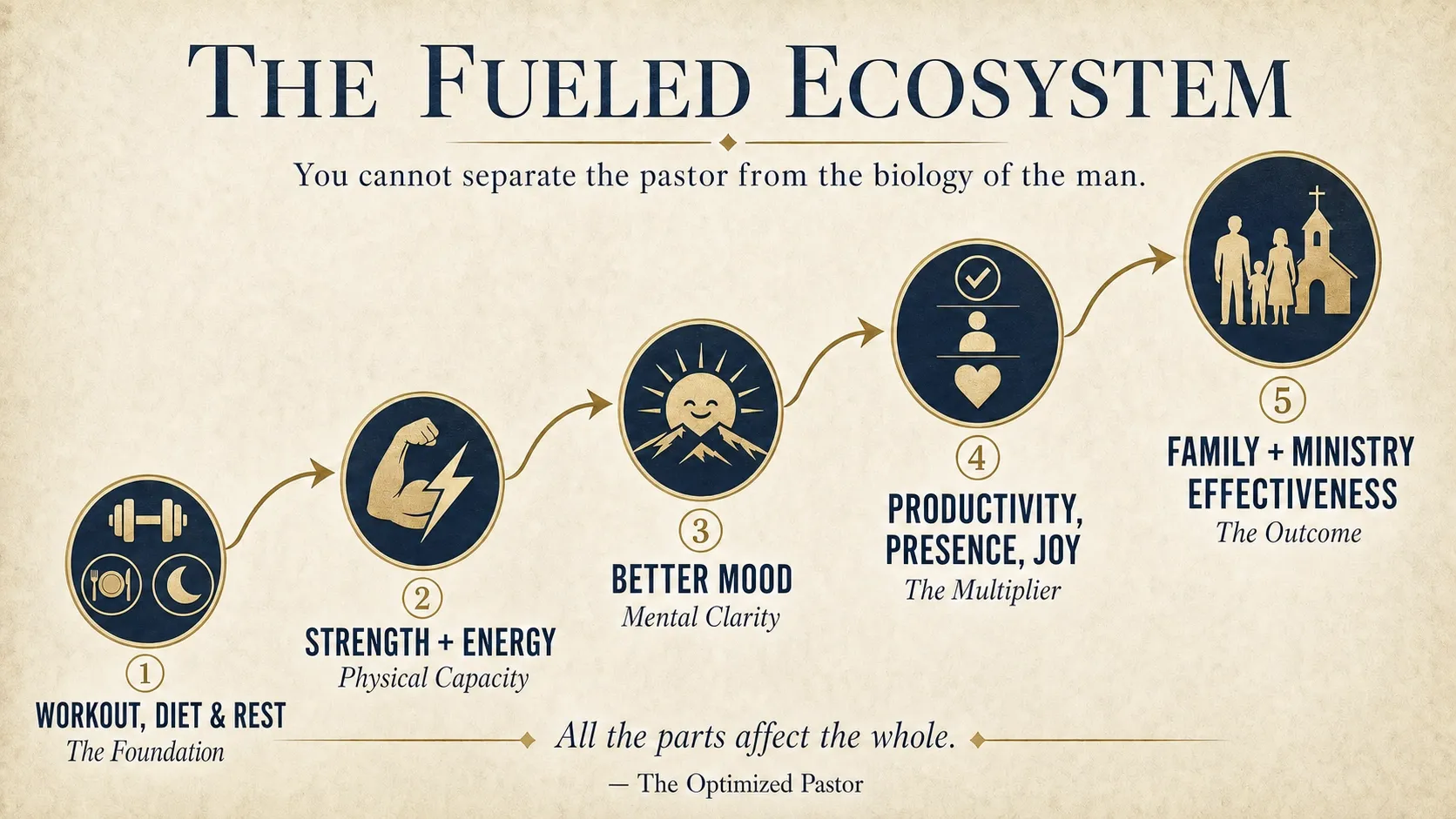
Your life is an ecosystem.
All the parts affect the whole.
For years, I treated my body, my schedule, and my ministry as separate compartments.
I thought I could out-preach a bad diet.
I thought I could out-pray chronic sleep deprivation.
I thought I could out-lead a schedule that had zero boundaries and apparently had been designed by a committee of caffeinated raccoons.
I was wrong.
The effectiveness of your ministry is directly tied to the health of your ecosystem.
For example...
When you work out, you build strength and energy.
That energy improves your mood.
That mood increases your productivity, your presence, and your joy.
And that joy translates directly into familial and ministerial effectiveness.
You cannot separate the pastor from the biology of the man.
You may be called, anointed, trained, ordained, and seminary-certified.
But you are still operating inside a body.
And if that body is running on Little Debbie cakes, four hours of sleep, and the adrenaline of unresolved church conflict, eventually the dashboard lights are going to come on.
When I finally understood this, everything changed.
I stopped treating my health as a side project and started treating it as the vehicle for my calling.
If you are exhausted, running on fumes, and wondering how much longer you can keep this pace up, you don’t need another conference.
You need a framework.
Here are the five pillars I use to keep my energy high, my mind sharp, and my ministry protected from the burnout that takes out so many good men.
1. Time Blocking Without Apology
If you do not tell your time where to go, your congregation will tell it where to go for you.
And they will not use Google Calendar.
The default state of pastoral ministry is reactive.
You are a professional interruption-handler.
Your day can go from sermon prep to a counseling crisis to a toilet overflowing in the preschool hallway before your coffee has cooled.
But you cannot build anything of lasting value—a sermon, a strategic plan, a healthy family—in the margins of other people’s emergencies.
You have to block your time, and you have to do it without apologizing.
This means deciding in advance when you study, when you meet with staff, when you answer email, and when you go home.
It means putting those blocks on a calendar and defending them with the same intensity you would defend a theological conviction.
Because for some pastors, “I’m unavailable from 8:00 to 11:00 for sermon prep” feels more controversial than taking a position on the book of Revelation.
But it has to be done.
The Protocol:
Identify your deep work hours.
For most guys, this is the morning.
Block 3-4 hours for sermon prep and strategic thinking.
Turn off the phone.
Close the email tab.
Train your staff that unless the building is on fire or someone is in the ICU, you are unreachable during this block.
You are not being inaccessible.
You are being faithful to your primary calling.
Your people do not need a pastor who instantly responds to every text.
They need a pastor who has heard from God, studied the Word, and is not trying to build Sunday’s sermon out of fumes and panic at 11:47 PM on Saturday night.
2. Removing Drains and Friction: The Subtraction Strategy
Optimization isn’t just about adding good habits.
It’s about ruthlessly subtracting the things that drain your energy and create friction in your life.
In ministry, drains are everywhere.
It’s the committee that doesn’t need to exist but meets every month anyway, possibly because it was established in 1978 and nobody has had the courage to ask why.
It’s the volunteer who requires three hours of emotional management for every one hour of actual serving.
It’s the disorganized desk, the cluttered inbox, the chaotic morning routine.
It’s the meeting after the meeting.
Then the follow-up meeting to discuss why the first meeting didn’t solve anything.
Friction slows you down.
Drains bleed you out.
You have a finite amount of decision-making energy every day.
Every time you have to navigate unnecessary friction or manage an energy drain, you are stealing focus from the things that actually matter.
And the frustrating part is that most of these drains do not feel dramatic.
They just quietly siphon away your energy until you’re sitting at your desk at 3:15 PM staring at a blinking cursor, wondering why your brain has left the premises.
The Protocol:
Audit your life for friction.
What is consistently frustrating?
What meetings produce zero fruit?
What relationships are chronically draining?
What tasks make you want to fake your own disappearance and start over as a goat farmer in Montana?
Automate what you can.
Delegate what you shouldn’t be doing.
And have the courage to eliminate the rest.
Say no to the good so you have energy for the essential.
Not every opportunity is an assignment.
Not every request is a calling.
And not every meeting deserves oxygen.
3. Resistance Training: The Non-Negotiable Anchor
Let’s get something out of the way.
You are not lazy.
You are someone who has 47 things competing for the same Tuesday.
And somewhere between the elder meeting, the hospital visit, and the sermon that isn’t writing itself, the gym didn’t make the cut.
I understand.
The gym often feels like one more thing.
One more appointment.
One more place where people are wearing shirts that say things like “Beast Mode,” while you’re just trying to figure out how to use the machine without becoming a sermon illustration.
But here is what happens when you lift heavy things:
Your body changes at a chemical level.
When you lift—really lift, meaning compound movements with meaningful weight—your body releases testosterone and growth hormone.
Your metabolism shifts.
You trigger the release of myokines, those “hope molecules” your muscles release when they contract.
Your brain gets the benefit every time you show up.
Resistance training is not about looking good in a medium-sized polo shirt.
Though, let’s be honest, nobody has ever complained about that.
It’s about building the physical resilience required to carry the emotional weight of ministry.
The pastor who lifts handles the 11 PM crisis call differently than the one who doesn’t.
Not because he is more spiritual.
Because his nervous system is stronger.
His body has been trained to bear stress.
His brain has been trained to recover.
His energy system is not held together by caffeine, adrenaline, and the grace of God alone.
The Protocol:
You don’t need five days a week.
Two days of resistance training per week produces approximately 80% of the results of four to five sessions.
Monday and Thursday.
Tuesday and Friday.
Whatever two days you can protect like a board meeting with God.
Forty-five minutes.
Compound movements.
Show up, do the work, go lead your church.
You do not need to become a bodybuilder.
You do not need to start weighing chicken breast in Tupperware like you’re preparing for a documentary called Pastor Shredded.
You just need to get strong enough that your body becomes an asset to your calling instead of a liability you keep ignoring.
4. Low-Carb, Whole Food Eating: Fuel, Not Feelings
Most pastors eat like unsupervised teenagers at a youth retreat.
Donuts in the staff meeting.
Pizza at the men’s breakfast.
Fast food between counseling sessions.
Leftover cake from the fellowship hall.
A handful of chips eaten over the sink like a raccoon with a seminary degree.
We use sugar and refined carbohydrates to medicate the stress of ministry.
The problem is the crash.
When you eat a high-carb meal, your blood sugar spikes, insulin floods your system, and two hours later you are staring at your sermon notes through a fog of lethargy, wondering why the apostle Paul suddenly feels so hard to understand.
Food is not a reward for surviving a hard elder meeting.
Food is fuel for the ecosystem.
When you shift to a low-carb, whole-food approach—meat, vegetables, healthy fats—you step off the blood sugar roller coaster.
Your energy stabilizes.
Your brain fog lifts.
You stop needing a nap at 2:00 PM.
You also stop living in that strange pastoral food cycle where you repent every Monday morning and then somehow end up eating banana pudding by Wednesday night because “someone made it with love.”
Love is wonderful.
So is stable insulin.
The Protocol:
Cut the sugar.
Ditch the refined grains.
Eat protein-heavy meals that keep your insulin stable.
Build meals around meat, eggs, fish, vegetables, and healthy fats.
Keep it simple.
You do not need a complicated nutrition plan that requires a spreadsheet, a food scale, and the emotional energy of planning a mission trip.
You need repeatable meals that work.
Burgers without the bun.
Steak and vegetables.
Eggs and sausage.
Chicken and salad.
Taco bowls without the tortilla.
Food you can actually eat in real life.
When your congregation—whether they know it or not—gets a pastor whose brain is running on clean fuel instead of a sugar crash, they get a completely different leader.
They get more clarity.
More patience.
More presence.
And fewer sermons secretly powered by desperation and powdered creamer.
5. Sleep and Recovery: Fixing the Chemistry
Sleep is not the foundation of optimization.
It’s the foundation of the foundation.
Every supplement you take works better when you sleep well.
Every cognitive tool you deploy is sharper.
Every hard conversation you navigate is handled with more grace.
But most pastors are terrible at sleep because they treat it as an afterthought.
They go from sermon prep, church Facebook comments, budget concerns, deacon texts, and “one quick email” directly to the pillow.
Then they wonder why their brain won’t shut off.
Of course it won’t shut off.
You took your nervous system through a haunted house and then asked it to sing a lullaby.
Your room is sending signals to your brain all evening long.
Light levels.
Temperature.
Stimulation.
Screens.
Noise.
That last glance at your phone where you discover someone posted a theological opinion online that could legally qualify as a cry for help.
You have to fix the environment.
And you have to fix the chemistry.
The Protocol:
Screens down 60 minutes before bed.
Switch to warm lighting in the house.
Transition your brain from problem-solving mode to rest mode by reading fiction or a biography.
Read something that pulls your attention into a story that has nothing to do with your church budget, the next sermon series, or whether the worship leader’s new song choice is going to start a congregational uprising.
And fix the chemistry.
A simple stack of magnesium glycinate, L-theanine, and maybe ashwagandha in the evening tells your nervous system it’s allowed to stand down.
Sleep like a man who finally stopped arguing with his own biology.
Not like a man who believes holiness requires answering emails at 12:38 AM.
The Ecosystem Requires Maintenance
You cannot separate the pastor from the man.
When you lift weights, eat clean fuel, protect your time, prioritize your sleep, and remove the friction from your life, you are not being selfish.
You are building an ecosystem capable of sustaining the weight of ministry for decades.
Burnout is not inevitable.
It is the predictable result of ignoring the ecosystem.
You can love Jesus and still need sleep.
You can believe the Bible and still need protein.
You can be called to ministry and still need to stop treating your body like a rental car with unlimited mileage.
Start with one pillar this week.
Fix your sleep.
Or block your Tuesday morning.
Or get in the gym for 45 minutes.
Or eat a meal that does not come wrapped in paper and handed to you through a window.
Watch what happens to your energy, your mood, and your preaching.
The pastor who protects his ecosystem protects his ministry.
Go get it.