


For years, I thought getting leaner meant doing more.
More cardio.
More supplements.
More rules.
More tracking.
And alot of days-per-week in the gym.
I thought engaging in fitness would be like adding a second job.
And I already had one.
Actually... two.
Once I actually started (and researching as I went), I went all in... on simplicity.
This became my approach to body recomposition (the process of losing fat while building or preserving muscle).
Intensely uncomplicated.
This "before" pic in the morph (gif below) doesn't do a good job of showing the stretch of my waistbands during that era.
That gray shirt hides it.
All my pants had gotten tight.
I needed to lose belly fat and gain muscle.
In the first 18 months of my recomp plan, I was swapping fat for muscle weekly.
Here's that transformation...
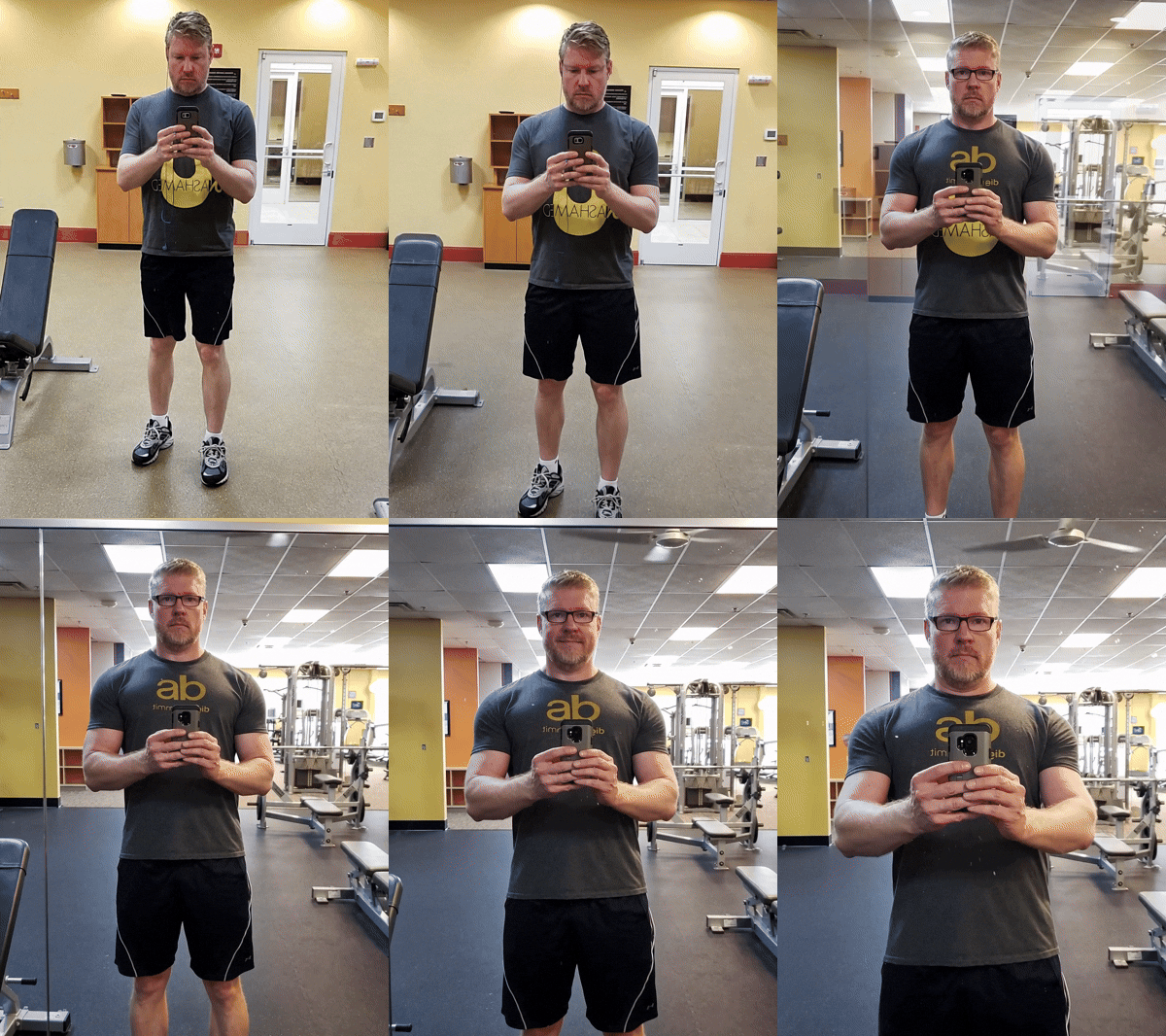
So my body recomp plan worked.
That plan isn't perfect.
It's not the only way.
But it's the simplest plan I've found that consistently works for me.
And that's become one of my filters these days.
If it's too complicated to sustain during revival meetings, mission trips, conferences, and long drives or flights...
...it's probably too complicated.
Here are the four things I focused on then to make the recomposition plan work so well.
1. Eat More Protein Than You Think You Need
This was probably the biggest change.
Instead of obsessing over calories, I started obsessing over protein.
Not in an unhealthy way.
Just intentionally.
My target became about 0.85 grams of protein per pound of body weight.
That sounds like a lot.
It is.
(And yes, I measured.)
Which means every meal starts asking a different question.
Not...
"What sounds good?"
But...
"Where's the protein?"
Chicken.
Lean beef.
Eggs.
Greek yogurt.
Protein shakes.
Cottage cheese.
Suddenly, the meal almost builds itself.
Protein does something remarkable.
It helps preserve muscle while you're losing fat.
It helps keep you full.
And when you're trying not to inhale an entire plate of church fellowship desserts, feeling full is a wonderful thing.
Speaking of church...
If your church office is anything like most churches, there's an unwritten law that says donuts must appear whenever two or more staff members are gathered.
I love donuts.
I just love fitting into my pants more.
2. Lift Weights Three Times Per Week
Notice what I didn't say.
Six days.
Two-hour workouts.
Professional bodybuilding.
Three days.
That's it.
Can't do three?
Ok, minimum two.
When you resistance train, you're telling your body,
"This muscle is still needed. Don't get rid of it."
Without that signal, losing weight often means losing muscle too.
That's not the goal.
The goal isn't simply becoming lighter.
It's becoming stronger.
I also quit worrying about trying to out-train twenty-three-year-olds who film every set for Instagram.
I'm fifty-something.
My goal is no longer to look like an action hero.
At this point I'd settle for looking like I know where the gym is.
Joking aside, I'm trying to be healthy enough to enjoy my grandkids and faithful enough to serve Christ for decades.
Different goal.
Different scoreboard.
3. Intermittent Fast Until Lunch
This one scared me at first.
I thought I'd be starving all morning.
Turns out, I mostly wasn't.
My mornings became simple.
Black coffee.
Sparkling water.
Work.
Lunch.
That's it.
I'll be honest.
Black coffee took some getting used to.
The first few days I wasn't sure whether I was drinking coffee or punishment.
Then something strange happened.
I started liking it.
(Stockholm syndrome?)
Intermittent fasting isn't magic.
But it naturally reduced the amount I ate without feeling like I was constantly counting calories.
It also removed another decision.
Breakfast was no longer a debate.
Oh...
And I stopped eating by 7 pm.
4. Eat Mostly Real Food
Notice I said mostly.
Not perfectly.
Mostly.
Meat.
Vegetables.
Fruit.
Healthy fats.
Low-carb.
Whole foods.
Could I still enjoy a nice meal out?
Absolutely.
Pastors get invited to breakfast.
Church members love taking us to lunch.
Someone is always celebrating something with cake.
I'm not interested in living like a nutritional monk.
But I also don't want every meal to be a surprise.
The more defaults I have, the fewer decisions I make.
And the fewer decisions I make, the more consistent I become.
Why This Combination Works
None of these habits are particularly revolutionary.
That's actually the point.
Protein helps preserve and build muscle.
Resistance training gives your body a reason to keep that muscle.
Intermittent fasting naturally helps reduce calories without obsessing over every bite.
Whole foods make it much easier to stay satisfied.
Together, they create an environment where your body can gradually lose fat while maintaining (or even adding) lean muscle.
People sometimes call it a "lean bulk" or body recomposition.
I just call it keeping things simple.
What I Didn't Do
Notice what's missing.
I didn't spend hours on the treadmill.
I didn't count every calorie.
I didn't buy a shelf full of supplements.
I didn't eat six tiny meals a day.
I didn't carry a food scale into Cracker Barrel.
(I'd like to continue getting invited to breakfast.)
The older I get, the less interested I am in finding the perfect health plan.
I'm interested in finding one I can still be doing five years from now.
One Final Thought
Pastors are busy.
Really busy.
If our health plan requires Olympic-level scheduling, we probably won't stick with it.
That's why I've become convinced that the best health plan isn't the most advanced one.
It's the one that's simple enough to survive real life.
Mission trips.
Conferences.
Hospital visits.
Vacation.
Airport terminals.
Late-night committee meetings.
(And church potlucks where Sister Martha assures you that "it's healthy because it has pecans.")
Because the goal isn't to have the most impressive fitness strategy.
The goal is to faithfully steward the body God has entrusted to us...for the long haul.
More Resources To Help You Optimize
💊 My (Scott's) full supplement regimen